|
|
|
| |
Preset Demos
Listen to some of the 2'500 presets that come with OP-X PRO-II. Except for drums in the song examples
all sounds are coming from OP-X PRO-II. No external effects have been involved. Each sound can be auditioned with the demo version.
Famous Bank:
 Live is for Living
Victims of Circumstance
99 Luftballons Strings
99 Luftballons
Save a Prayer
Gimmie Gimmie Gimmie
Break Free Intro
I Want You Break Free
Radio Ga Ga
Holiday
New Song
I Want To Know
Money Piano
Toto Africa Brass
Halen Jump
Lucky Man Solo
Camera Eye
Separate Ways Intro
Solo Bank:
Mays Prophet Lead
Shine On Solo
OB Tuned Unisaw
OB Sync Solo
OB Sawtooth Solo
Pads Bank:
OB Amazona Pad II
Matrix-12 Reso Pad
Saulino Soundtracks
Jupiter Super Pad
Jupiter Glacial Pad
Matrix Monster Pad
Strings Bank:
Matrix Mod Strings
OB Lush Superstrings
OB Simple Strings
OB Drifting Strings
OB Supersoft Strings
HP Slowmod Strings
Matrix Softstrings II
Matrix Power Strings
OB Lush Strings
Prophet Warm Strings
Matrix Monster Strings
Clavinet Organ:
Warm Clavinet
Amped Clavinet
Electro Reso Clavinet
DW8000 Organ
Dark Warm Organ
Mixed Banks:
Drums Presets
Matrix FM Bells
Sampled Vibrato
Filter Morphing
Mystic Spaces Cluster
Sweeps Bank:
Matrix Sweeps
Matrix Lush Sweeps
OB-X Sweep
OB-X PWM Sweep
OB-Xa Upsweeps
Reso Notch Sweep
Brass Bank:
OB-8 Brass Ensemble
OB Monobrass
Prophet Brass Stab
Prophet Hi Brass
Prophet Soft Brass
Prophet Mellow Brass
Jupiter Mono Brass
OB-8 Full Brass
OB-Xa Brass Ensemble
Chroma Brass
Matrix Brass Strings
Arpeggio Bank:
Supersoft Pulsearp
Jupiter Arpeggio
Reverse Pulsearp
Moving Multimode
Pulse Multimode ARP
OB-X Bank:
OB-X Porta Brass
OB-X Upsweeps
OB-X Sweepchords
OB-X Porta Chords
OB-X PWM Velosweep
Bass Bank:
Fretless Bass
Holiday Bass
Floyd Signs Bass
Electro Bass
Taurus Bass
Minimoog Bass
Matrix Bank:
Bandpass Chords
BP Stereomod Pad
Sync Notch Sweeps
Long Wave Receiver
Rising MM Chords
Matrix FMod Bumps
Human Voice Percpad
Hires FM Portasweep
Magic Mistery Brass
Strange FM Arpeggio
XPander Landing Jet
Jupiter Bank:
Jupiter Neg Pluck
Jupiter NP Jam
Jupiter Lo Strings
Jupiter Neg Sync
Jupiter Narrow Perc
Jupiter Classic Harp
Jupiter Arpeggio
Jupiter Super Pad
Jupiter Neg Perc
Jupiter Rubust Strings
Jupiter Clear Unisync
Jupiter Dark Strings
Polymoog Bank:
Numan Cars Lead
Abba Polymoog Brass
Eagle Polymoog
Synthex Bank:
Jarre Laser Harp
Synthex LFO Multmod
Synthex Lush Percpad
Synthex MM Sweep
Synthex Mod Strings
Synthex Dirty Cembal
Synthex Piano
Synthex Speed Arp
Prophet Bank:
Prophet Full Brass
Prophet Cosy Brass
Floyd Turns Prophet
Prophet Sawsync
Prophet Perc Solo
Prophet Echoing Sync
Prophet Unisync II
Prophet Toy Piano
Prophet Factory Clav
Prophet Clavichord
Prophet Upsweeps
Minimoog Bank:
MM Classic Bass
Duke Minimoog
Circle Minimoog
MM Dark Sawsolo
Fatback Minimoog
|
|
|
| |
|
|
| |
Interfaces
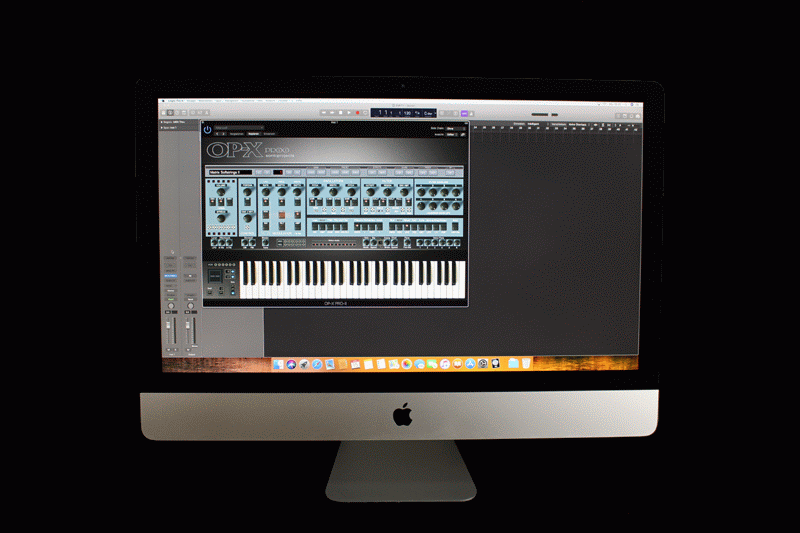
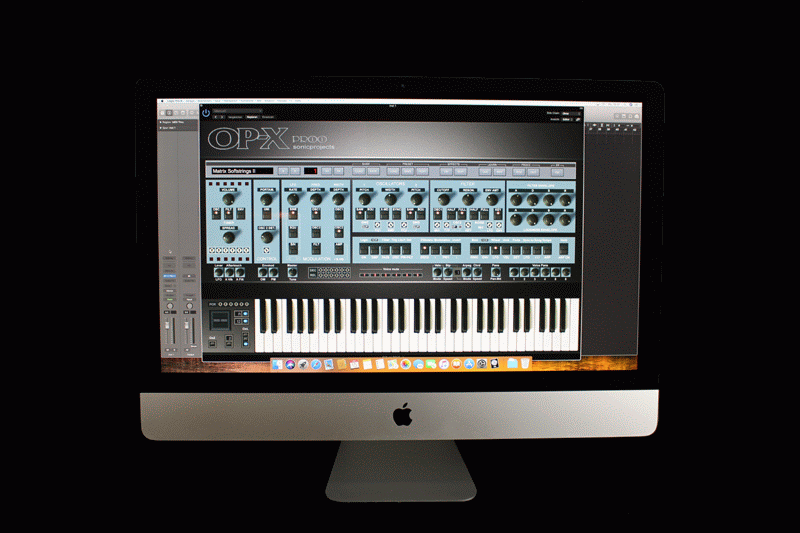
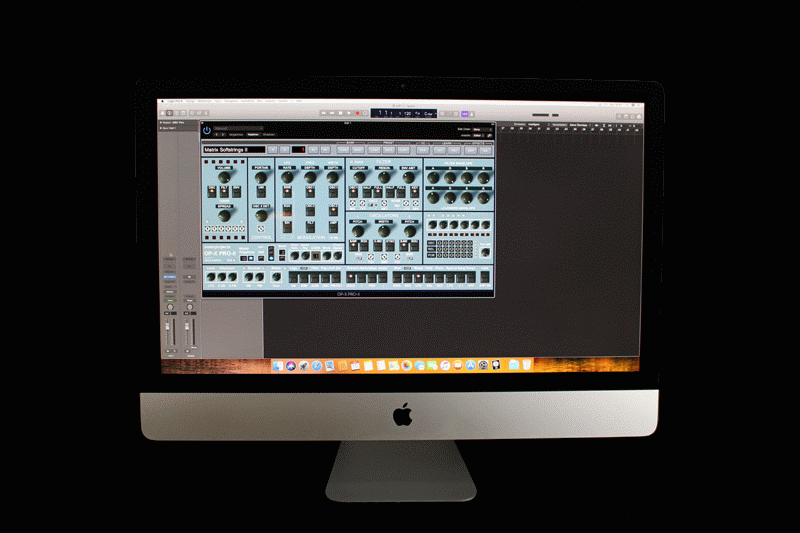
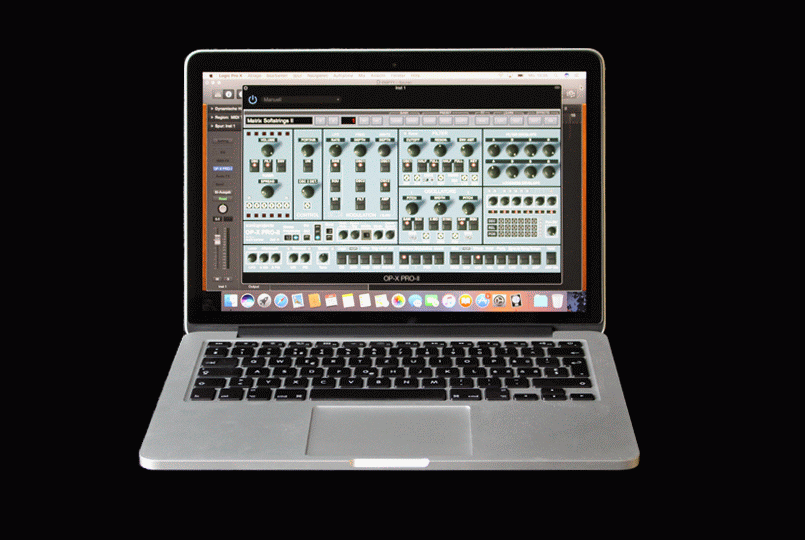
The synth offers two interface types each in three sizes to make editing comfortable on any screen from small
ultrabooks up to 4k studio screens and to fit anyone's preferences. Learn more about the interfaces
here.

The new Rack Edition interface version offers dedicated buttons for the hidden calibration features and text
labels for mapped parameters which makes editing a lot easier.
|
|
| |
|
|
| |
Music using OP-X PRO-II
How does OP-X PRO-II sound in a mix? Here are some selected examples from which we know from the producers themselves that all
sounds were done with OP-X:
Gigamesh - Producer of Mike Posner "Cooler Than Me":
"OP-X PRO is by far my favourite soft synth. I use it constantly. Of all the software and hardware synths I own, I use this one the most."
|
|
| |
Built-in Signature Soundpacks
Listen to some of the built-in signature soundpacks. Click on the icons to listen how they sound:
|
|
| |
Famous Songs Recreation
Here's some video examples of often searched sounds and whole soundsets for famous 80s songs the synth includes
ready-to-play in the included library. Click the speakers to watch. Info where to find the sounds in the popup-text:
|
Van Halen 1984
Van Halen Jump
Van Halen Why Can't This Be Love
Billy Idol Rebel Yell
Pink Floyd One Of My Turns
Pink Floyd On The Run
Pink Floyd Comfortably Numb
Is There Anybody Out There
BJH Life Is For Living
BJH Life Is For Living Berlin
Alan Parsons - Sirius
In Memory Of The Martyrs
|
|
Duran Duran Save A Prayer
Queen I Want To Break Free
Disco Funk D Train
Nena 99 Luftballons
Floyd Goodbye Blue Sky
Pink Floyd Mother
Pink Floyd In The Flesh
Wearing The Inside Out
BJH Waiting Borderline
BJH Victims Of Circumstance
Madonna Holiday
George Duke Love Reborn
|
Prince 1999
Rush The Camera Eye
Madonna Borderline
Pink Floyd Shine On
Pink Floyd Thin Ice
Any Color you Like
Pink Floyd Dogs
Pink Floyd Keep Talking
A-ha - Take On Me
BJH Back To The Wall
Manfred Mann Pluto
Marillion Incommunicado
|
|
Alphaville Forever Young
Steve Winwood Valerie
Simple Minds Don't You
Styx Come Sail Away
Floyd Shine On Leads
Run Like Hell Lead
Pink Floyd Hey You
Pink Floyd Empty Spaces
Toto Africa
BJH I'm Like A Train
Radio Ga Ga
Prince Lets Go Crazy
|
|
Full list of 80s sounds:
Famos 80s patches list
For a collection of ALL so far avaiable famous 80s patches download the "Famous Complete Collection"
from the
sound reloads site.
|
|
| |
|
|
Neil Palmer
Keyboard player and producer of Xavier Naidoo. He uses OP-X PRO-II live and in the studio with a Muse Research Receptor.
www.xavier.de
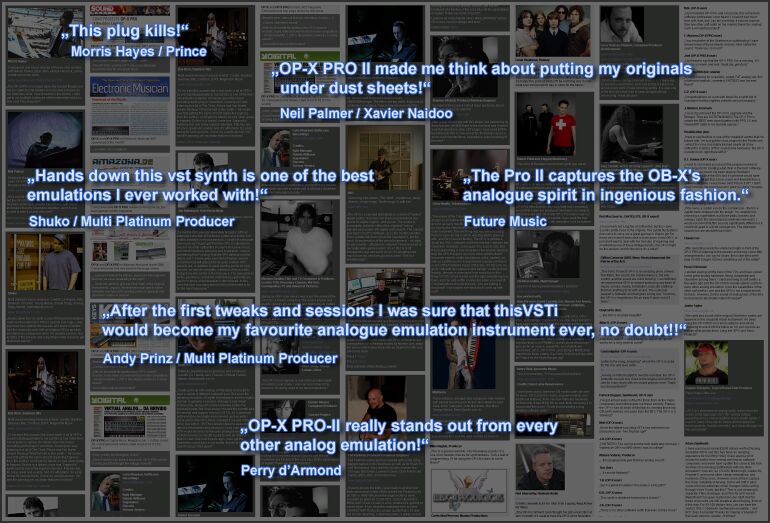
„I'm a cynical purist - I own a lot of original analog gear, but the OP-X PRO II made me think about putting my originals
under dust sheets! Fat, punchy, with faster envelopes than my Oberheim Xpander - and I'm not scared to take it on tour
with me!!!"
Neil Palmer has provided some presets in the user area
Palmer Mod Clav: listen
|

|
|
Shuko
Multi platinum music producer. Credits: Lil Wayne, Sido, Birdman, Omarion, Young Money, Snoop Dogg, Gimma, Bligg, Bandit, Keith Murray a.m.m.
www.shukobeats.com
„Hands down this vst synth is one of the best emulations I ever worked with!
OP-X PRO-II sounds real huge, I was suprised how realistic the basses and
leads sounded. I had the chance to work with an original OB-Xa and this emulation
is coming real close. It's actually a lot fun, fast loading of the presets and a big
libary make it easy to get stuff done quickly."
|
|
|
Morris Hayes
Keyboardist and music director of Prince. Has worked with Maceo Parker, Elton John, Herbie Hancock, Lenny Kravitz and many more.
www.openlabs.com/morris-hayes.html
„The OP-X PRO-II is hands down the closest thing to our OB-8 to date! It is fat, flexible and runs like a dream on my
Openlabs units. I use it heavily in the shows. I also get to run multiple instances of the instrument which is very cool!
This plug kills!"
More testimonials are available here
|
Testimonials
Claude Fox
„This is the best synth plug I EVER bought. It blows everything out of the water."
TheSoundTestRoom:
„This bad boy can emulate pretty much any of the classic analogue synths from way back in the day."
read more testimonials
|
|
|
| |
OP-X PRO-II - the ultimate dream machine!
|
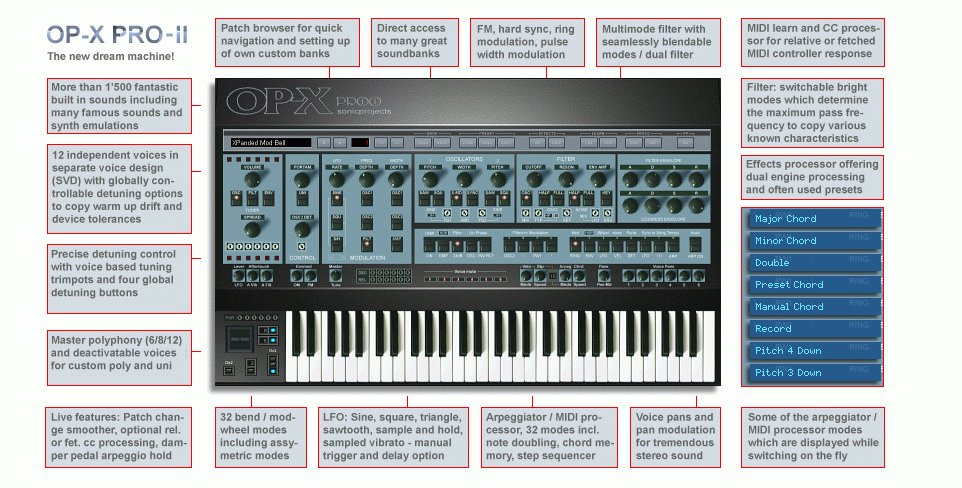
OP-X PRO-II is a 12-voice virtual analog synth originally based on the famous Oberheim OB-X. During its evolution the engine however was extended with
features borrowed from various other iconic synths of this era, which makes the synth incredibly versatile and allows it to clone the sounds
of almost any analog synth including Minimoog, Prophet-5, Jupiter-8 and Matrix-12.
OP-X PRO-II offers world unique features and a sound that will make your brain release endorphines. It will deliver the
fattest and warmest strings, pads, brasses and leads you've ever heard from a virtual synth. An included library of more
than 2500 of the finest presets inluding many of the most famous 80ies hits sounds and countless well known presets from
various classic vintage synths which are said to be the most authentic available on the market builds the base for your work.
Read more
OP-X PRO-II is a 12-voice virtual analog synth originally based on the famous Oberheim OB-X. During its evolution the engine however was extended with
features borrowed from various other iconic synths of this era, which makes the synth incredibly versatile and allows it to clone the sounds
of almost any analog synth including Minimoog, Prophet-5, Jupiter-8 and Matrix-12.
OP-X PRO-II offers world unique features and a sound that will make your brain release endorphines. It will deliver the
fattest and warmest strings, pads, brasses and leads you've ever heard from a virtual synth. An included library of more
than 2500 of the finest presets inluding many of the most famous 80ies hits sounds and countless well known presets from
various classic vintage synths which are said to be the most authentic available on the market builds the base for your work.
Read more
OP-X PRO-II is a 12-voice virtual analog synth originally based on the famous Oberheim OB-X. During its evolution the engine however was extended with
features borrowed from various other iconic synths of this era, which makes the synth incredibly versatile and allows it to clone the sounds
of almost any analog synth including Minimoog, Prophet-5, Jupiter-8 and Matrix-12.
OP-X PRO-II offers world unique features and a sound that will make your brain release endorphines. It will deliver the
fattest and warmest strings, pads, brasses and leads you've ever heard from a virtual synth. An included library of more
than 2500 of the finest presets inluding many of the most famous 80ies hits sounds and countless well known presets from
various classic vintage synths which are said to be the most authentic available on the market builds the base for your work.
Features like relative or fetched midi cc response, morphable filter modes, syncable panning modulation, arpeggiatable preset chords,
note doubling, LFO triggering with phase control, delay allowing for dotted and triple sync, filter brightness control, sampled vibrato,
dual engine effects processing and switchable filter self oscillation are hard to find in any other synth and allow OP-X PRO-II to do sounds you've never heard
before both in hardware and software.
OP-X PRO-II doesn't simply clone voices to achieve polyphony. Its unique Separate Voice Design (SVD) emulates the
exact audio signal flow and voices structure of real voltage controlled polyphonic analogue synths using a separate
independent monosynth for each voice including all the
slight variations and detunings between the single voices which gave these synths that lively and organic
sound. These detunings can be controlled globally and also can be edited in every tiny detail for each voice on demand.
The synth is supercharged with features inspred by a wide variety of classic analog synths and so it isn't
limited to emulating only one specific synth. Check the audioclips above to get an impression of its huge variety.
Dependent on the settings it can sound close to an Oberheim, a Jupiter-8, a Prophet-5 or even a Minimoog. It's
flexible voice engine featuring a separate pannable mono synth for each voice allows to include or exclude any voice of choice which can make it a Matrix-12 like
polyphonic monster synth, a classic four voice synth or even a simple innocent mono synth. Its morphable state
variable multimode filter offering switchable 12/24db slope and switchable self oscillation allows to achieve almost any
color since everything including the modes is seamlessly blendable.
But where others stop this synth only begins. Once all classic parameters are set you can start refining the
character of the whole system by using all the many voice-based detuning features which can make the synth sound
completely pissed off with a lot of detunings going on up to clean and precise to capture the sound of later
more behaved analog synths. This can be done intuitively and quickly on the fly using just four global buttons which
now also allow for seamless adjustment by clicking the label and dragging the mouse vertically -
or, if you really want to go into the tiny details, using the voice-based tuning trimpots to refine it. Not enough with
this you also can fine-tune the remaining beats between equally tuned oscillators 1 and 2 in order to emulate VCO
or DCO behaviour. All of this allows you
to achieve any thinkable character and you even can clone a dedicated real analog synth in every detail voice by
voice.
Last but not least the synth offers a bunch of unique features dedicated to live application which can help to make
a live performance completely glitch free, intuitive and smooth. These include a switchable relative or fetched response to
incoming controller data which eliminates the well known parameter jumps caused by deviating settings.
In fact both these methods were used in real programmable hardware-synths for editing saved patches.
A built-in
patch-change smoother makes patch switches over midi and increment or decrement buttons completely artefact free
by quickly fading out audio, releasing all notes and fading in again, all within the fraction of a second. This can be
complemented with a switchable parallel processing mode of the effects engine which lets the effects of the old
preset finish uncut while the new preset is directed to the other "free" engine. The effect engine itself offers a bunch of handy quick presets. Last but not least arpeggios and
sequences can be hold/started or released/stopped hands-free with the damper pedal by quickly depressing and
releasing it again time-filtered within less than half a second.
As you can see OP-PRO-II offers a lot. To be able to enjoy all of its sound possibilities off the shelf the synth comes bundled with
a huge library of 2'500 built in sounds plus even more downloadable in the regularly extended sound reloads area
which gives you a library offering tons of highly elaborated banks including many famous sounds as base for your work.

Let's have a look at its features:
General Features:
- 2 oscillators (saw, pulse, sine)
- fm, hard sync, ring mod, pw modulation
- morphable multimode filter (lp12/24, hp, bp, no)
- 2 LFOs (main, lever)
- LFO 1 waveforms: sine, square, saw, triangle, sample&hold, sampled vibrato
- LFO 1 features: delay, note trigger, free phase adjustment
- 2 ADSRs (Filter, Amp)
- ADSR 1: invertable, routable to pitch and pulse width
- ADSR 2: switchable attack (lin/log), routable to ring mod
- stacked unisono with variable amount of voices and spread control
- switchable legato or retrigger (uni/poly)
- polyphonic portamento with switchable spread and detuning
- arpeggiator offering 32 modes
- chord hold, sequencer, double mode
- built in effects processor (reverb/delay) offering presets
- switchable dual engine effects processing
- LFO, effects and arpeggiator syncable to song tempo
- 32 wheel modes, mod to cutoff, asymetric bending
- MIDI learn & relative or fetched CC processing
- CC remote patch switching
- Separate Voice Design (SVD)
- switchable master polyphony (6/8/12)
- deactivatable voices
- individual pan control per voice channel
- panning modulation
- global tuning options (OSC/FILT/ENV/POR)
- tuning trimpots per voice for custom tunings
- built in patch browser with patch change smoother
- 2500 built in presets
|
|
Live Features:
- Relative or fetched MIDI CC response info
- CC remote patch switching
- damper pedal arpeggio hold info
- patch change smoother info
- dual engine effects processing info
Engine Features:
- 12-Voice Separate Voice Design
- Independent unique voices
- Global tuning features
- Voice based tuning features
- Beating offset control
Arpeggiator Features:
- Input order and pitch order
- Randomized modes
- Chord hold and preset chords
- 8-step recorder
- Note doubling mode
LFO Features:
- Sine, square, sawtooth
- Sample & hold
- Sampled vibrato
- Note triggering, phase adjust
- Delayed starting option
|
|
|
| |
The multimode filter
|
|
Demo clips:
Load the PROII_TESTPATCHES bank presets 15 - 32 in the demo version to reenact.
|
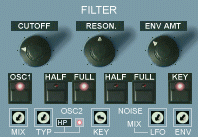
The morphable multimode filter of OP-X PRO-II offers an incredible dual filter design with
one filter working as 12/24 db lowpass and the other one working as multimode
filter that can blend its modes seamlessly from hipass over bandpass to notch. The two filters
can be blended and mixed seamlessly. This filter mix even can be automated by LFO or filter envelope.
Self oscillation for the lopass mode which is indicated by a small lamp can be activated with a triple
click on the 24db button.
|
|
Listen:
12dB SEM
24dB Self Reso
Self Reso as Partial
24dB Sweeps
Highpass
Bandpass
Notch
Mixed Notch w/ Reso
Env to Filtermix HP to LP
Env to Filtermix NO to LP
LFO to Filtermix LP / Highpass
LFO to Filtermix LP / Notch
Key Tracking 0%
Key Tracking 50%
Key Tracking 100%
|
For more details have a look at the comprehensive pdf manual:

|
|
| |
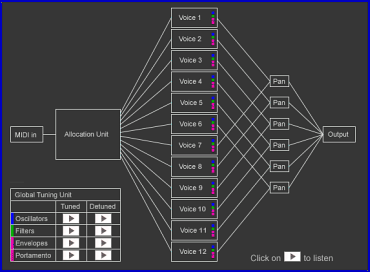
Separate Voice Design
As its smaller brothers OP-X PRO-II uses no common voice cloning to achieve polyphony.
Instead each voice is a separate mono synth with individual signal path and slightly
different sound by default, exactly the same as in a real voltage controlled analog synth
where each voice has its own electronics including individual device tolerances, slightly
deviating calibrating, aging influences and warm up drifts. As example this is a single
voice of a 1979 OB-X:
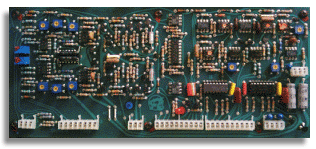
OP-X PRO-II emulates these separate voices including all the slightly individual drifts
and deviating calibrations, and this now for full 12 voices, similar to e.g. a Matrix-12.
But unlike in the old originals OP-X PRO-II offers the ability to take full control
over these detunings, both with global tuning buttons and too a lot of trimpots that
allow to calibrate individual voices for custom detunings, and this all individually
for four sections: oscillator pitch, filter cutoff, filter envelope times and portamento
times. Each voice too has its own pan-control. This all spends OP-X PRO-II an incredible
sound, which captures the livelyness and fatness of a real polyphonic analog synth.
Watch this video featuring the smaller brother OP-X PRO which shows how the Separate
Voice Design works:
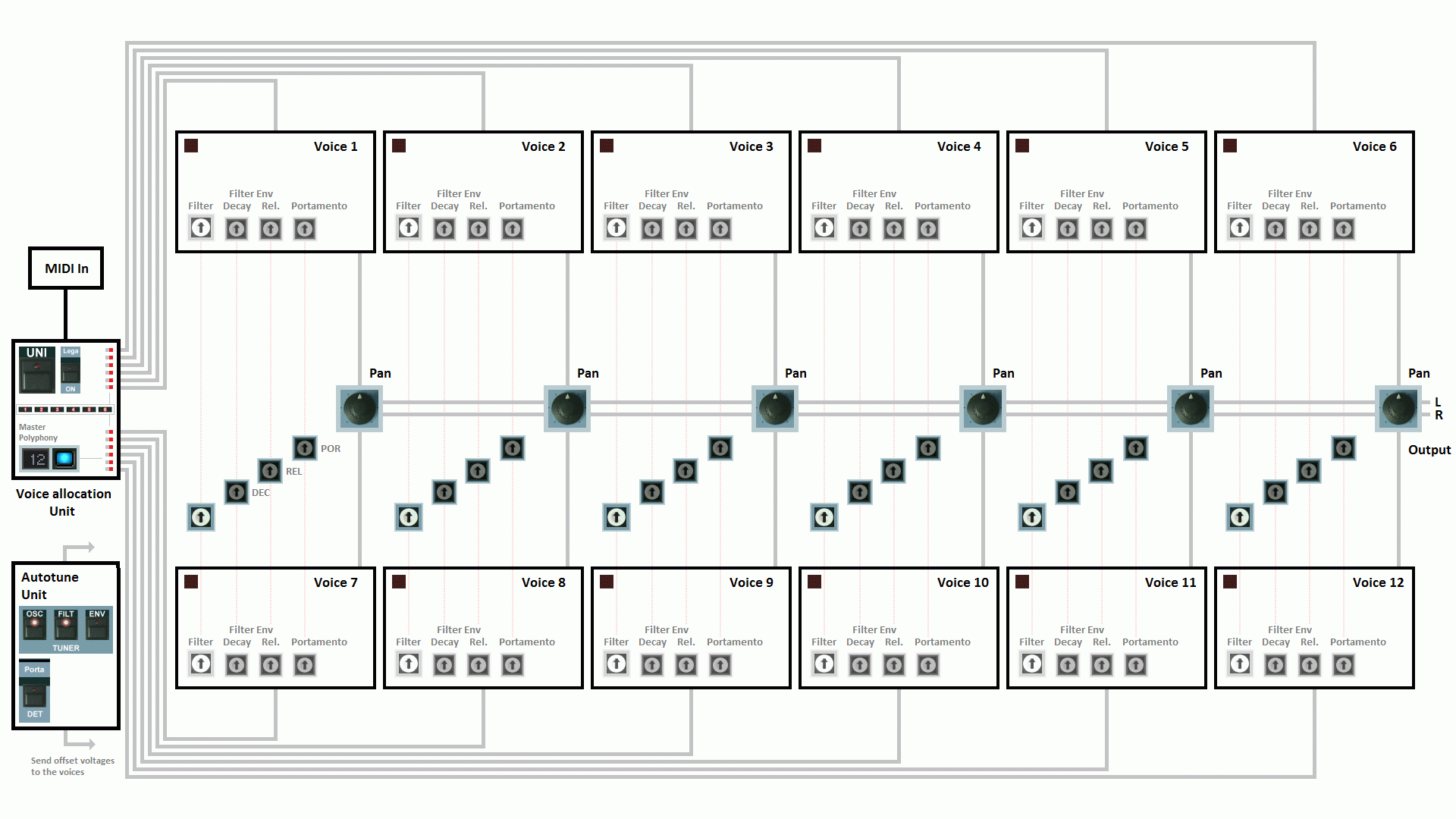
SVD extensions in OP-X PRO-II: Doubled number of voices (12), switchable master polyphony (6/8/12),
deactivateable voices (also in polyphonic mode), optional seamless detuning control and one-click
calibration option for the tuning trimpots. To keep things handlable and compatible to former sounds
the tuning trimpots, pan controls and voice mutes always control the two corresponding voices of the
upper and the lower voice bank at the same time, which makes it easy to play with polyphony without
the need of calibrating the voices of the lower bank individually. This video shows how the master
polyhony and the voice deactivation works:
The tuning system:
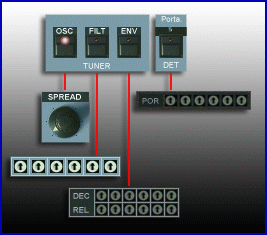
The tuning system is divided into four parameter groups: oscillator pitch (OSC), filter cutoff (FILT),
filter envelope attack and decay times (ENV) and portamento times (Porta DET). Each section has its own
global tuning button that either can switch on and off the voice-based detunings or can blend seamlessly
between the detuned and tuned mode with the new seamless control function by clicking on the text label
and dragging the mouse vertically (see below). In the detuned mode the detunings of the individual voices
are determined by the trimpot settings. The twelve-o'clock setting does not mean tuned, it represents the
standard detuning which is comparable to an average not freshly calibrated polyphonic analog synth. The
trimpots can be freely adjusted for custom detunings or calibrated with the new one-click calibration
feature (see below). The pitch section has no individual trimpots, its detuned mode has chaotic
settings which are comparable to a voltage controlled analogsynth right after switching on before applying
auto tune. The detunings of the pitch section however also can be independently and seamlessly controlled
with the spread knob which too works in polyphonoc mode. In tuned mode (led on) spread is great to add just
a tad bit of unpureness.
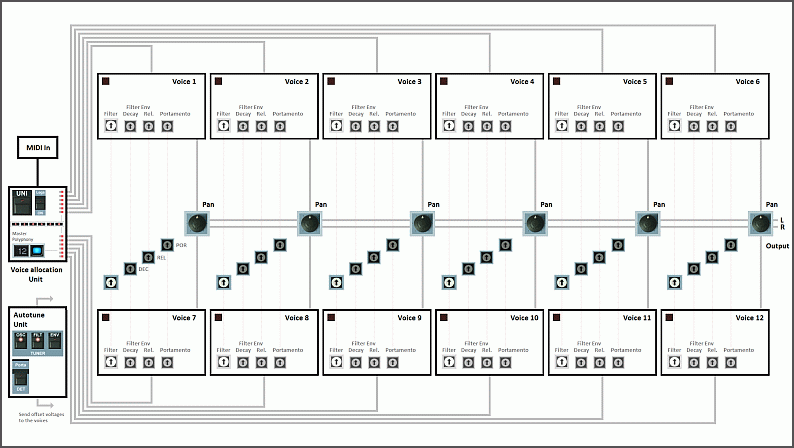
Block diagram of the voice engine of OP-X PRO-II which is similar to Matrix-12 with two 6-voice Xpander boards
|
|
| |
Effects Unit

The top bar includes an effects unit offering reverb and delay. The unit
can be quickly switched on and off with just one button. The edit button
opens the hidden panel for detailed parameters. By clicking on the small
down arrow a choice of handy quick presets can be accessed that can be
checked through on the fly. The delay can be synchronized to the host and
to the arpeggiator in normal, triple and dotted mode. If the arpeggiator
is on the sync source is the arpeggiator automatically, which can be synchronized
itself to the host. PP activates parallel
processing using two separate effect units which makes it possible to let
finish the effects of the previous preset uncut while the new preset can be
used immediatly with its own effect settings.
|
|
| |
Patch Browser

The top bar includes a very handy new patch browser which allows for
easy navigation within patches, load and save banks and patches from
and to a standardized central location. The patch browser also allows
for easy renaming and quick one-click saving of own custom patches
which can be used then to create own custom banks. There are two patch
list launch down arrows, one for a temporary list that again disappears
after having chosen a patch, and the other one for a locked list that allows
to browse around in what's available in the currently loaded bank. Other
than the standard windows lists you might know from your host these lists
remain in the last chosen scroll position, which makes anoying back
scrolling to patches in deep positions unnecessary. When using the increment
decrement buttons or MIDI program changes to switch patches, then patch
changes are smoothed with an intelligent algorithm that very quickly fades
out the last patch and again in the new one for completely smooth and
artefact free patch changes.
|
|
| |
New Arpeggiator
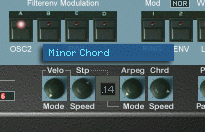
A completely new arpeggiator/MIDI processor offers an incredible variety of features, more than you
would guess from its simple appearance. The mode knob lets you morph in realtime through 32 different modes.
Dependent on the chosen mode the neighboured knobs become controls for various sub-functions. The offered
modes include:
- normal arpeggios: 1-4 octaves, up/down/up&down, pitch order/input order/random
- 3 step sequencer modes
- 8 step note recorder
- chord hold
- preset chords
- double mode
For hands free operation arpeggio hold and start/stop in the record mode can be applied
by the standard damper foot pedal, which works with a time gate then. To access it you
have to depress and release it again within less than half a second.
|
|
| |
CC Processor
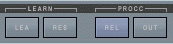
The synth offers an included MIDI learn engine which allows to map almost any of the synth's controls
to an external hardware controller via MIDI continuous controllers in a very fast and easy way for
parameter editing like in a hardware synth.
To avoid the well known parameter value jumps resulting in hard sound changes OP-X PRO-II furthermore
offers a feature which is quite unique amongst VSTis: relative or fetched CC response, switchable on
demand with the left button below "PROCC". In relative (REL) mode the GUI knobs only respond relatively
to incoming CCs, so they don't jump to the actual value. In fetched (FET) mode the current value has to be
fetched until the knob starts moving.
Furthermore the synth lets you remotely switch patches within a loaded bank via MIDI continuous
controllers in a very comfortable way. The synth even offers different methods for this: By mapping
the increment/decrement buttons, by direct patch access via rotary control and by traget patch preparation
and switch trigger. Note: Mac and windows 64bit version only. The windows 32bit version in return offers direct
MIDI program change and MIDI feedback.
|
|
| |
Bending modes

While still offering the two most common bend intervals (2/12) directly switchable with the blue
square button, there are now 32 additional modes that can be accessed by clicking into the small number
display and dragging the mouse vertically. A dedicated cluster of coloured points indicate then the
active mode. Have a look at the pdf manual for a complete table showing all modes.
The modes include all intervals from 1 to 12 joined by 3 ultrawide modes (2,3 and 4 octaves) for extreme
bendings, as well as several asymetric modes (different interval for up and down) and modes where the
modulation wheel is routed to filter cutoff. There are also modes that map the modulation wheel to
bending to have up to three independent different bending intervals for special situations.
|
|
| |
Continuous control
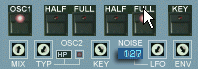
OP-X PRO-II now allows to adjust the values of a bunch of button parameters (previously only two state)
seamlessly on demand by clicking on the text label just above the button and dragging the mouse vertically.
A small number display will show the current value then. The state of the button's LED will change when
the 50% mark is overriden, and the values are reset to 0 or 127 by clicking the button in the normal way.
The seamles control feature is available for the following buttons:
Oscillators: OSC1, OSC2 FULL, NOISE FULL
Tuner: OSC, FILT, ENV, Porta DET

So as you can see this new feature allows to adjust oscillator and noise levels seamlessly and it too allows
to adjust the amount of detunings per section seamlessly, so there's free blending available now between the
tuned mode and the custom tuning as defined by the tuning trimpots. Of course the simple on/off functionality
still works and can be used as well furthermore if no detailed adjustment is necessary.
|
|
| |
Quick calibration
To make life easier OP-X PRO-II now offers a bunch of one-click calibration options
for all tuning trimpots, the filter trimpots and some chosen knobs like master tune
and OM PM. Clicking into a pre-defined area calibrates these controls into an often used
setting, which can be difficult or time-consuming to do manually. E.g. the tuning trimpots
can be calibrated to equal tuning and back to standard detuning, the filter multimode trimpots
can be zeroed all at once for pure lopass operation, or the master tune knob can be re-set to
its exact center position. To gain an overview on all these hidden areas have a look
at the "activeareas" page.
Visit activeareas page
|
|
| |
Voice panning

One of the positive side effects of the separate voice design is that each voice has its own pan
control (in PRO-II each voice channel) and so the voices can be freely distributed in the stereo
field which results in a terrific broad sound. Not enough with this, OP-X PRO-II even
allows to modulate the individual pans by LFO (Pan-Md knob) which makes pads sound as warm and rich
as you have never heard it before.
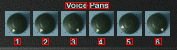
For even more easy handling OP-X PRO-II now offers a bunch of quick calibration options for the pan
knobs which you won't miss anymore once you have discovered them. These can be accessed by clicking
on pre-defined arreas:
- Click on "Voice": all pans are re-set to exact center position
- Click on "Pans" and drag the mouse vertically: spreads the pans seamlessly (lrlrlr)
- Click on the numbers: Switches the pans to 6 usable preset settings
|
|
| |
Bright modes
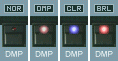
Formerly known for a sound more on the warm than the bright side OP-X PRO-II now offers
four different modes. The NOR and DMP ones already are known from OP-X PRO, CLR and BRI are
the two new bright modes, that can be convenient for some type of sounds. Here are the modes:
- NOR (normal): warm sound, the filter always tames the signal a bit, even when fully opened
- DMP (daped): the filter is damped down, which can be convenient in combination with key tracking
- CLR (lear): the filter can be opened into the ultra sound area for for a clear sound
- BRL (brillant): same as CLR, but with some added edge at the very top
These modes can be helpful to emulate different historic analog synths. The early obies e.g. had
a very bright sound (BRI), Jupiter still bright but more neutral (CLR) while later ones like
Matrix 6 or Junos had a less bright warmer sound (NOR). The best setting for most sounds still
is NOR since it has a warm and pleasing sound. Only use CLR or BRI when you really need the
added brightness.
|
|
| |
New LFO features
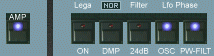
The new main LFO features include three new waveforms (sawtooth, triangle, sampled vibrato) as well
as switchable LFO delay and manual trigger options. Most of these features are hidden and have no
reference on the GUI, so you have to know about them.
- sawtooth: activate sine & s/h together; invertable to falling with the "Lfo Phase" buttons
- triangle: activate all three wave buttons together
- sampled vibrato: in s/h mode set the "AMP" button to blue mode; feeding lfo = lever lfo
- LFO delay: set the "Lfo Phase:OSC" button to blue; delay: Velo/Mode, rise time: Stp/Speed
- LFO note trigger: set the "Lfo Phase:PW Filt" button to blue; adjust phase with trimpot below Osc2
Have a look at the manual for details. The sampled vibrato wave works the same as sample & hold, but
instead of noise it samples the sine wave of the lever LFO, which results in a repeated stepped wave.
So the result depends too on the lever LFO rate.
|
|
| |
New envelope features
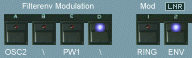
The new envelope features include switchable inversion of the filter envelope (switch "\" to blue) which
can be useful to emulate some Jupiter-8 type sounds, and the option to switch the response of the amp
envelope attack to linear (switch ENV to "LIN") which can be convenient for very slow attack strings
and pads. For the smoothest results too activate legato (Lega ON, no too works in polyphonoc mode). Especially
for strings this can deliver incredible results.
|
|
| |
Comparison
Due to its extremely flexible architecture OP-X PRO-II is able to emulate the character and the sounds of various classic analog synths including OB-X, Jupiter-8,
Prophet-5 and Matrix-12. Here's a direct comparison to an OB-X:
|
|
Sweep 1 OB-X
Sweep 1 OP-X PRO-II
Sweep 2 OB-X
Sweep 2 OP-X PRO-II
Pmpad 1 OB-X
Pmpad 1 OP-X PRO-II
|
|
Pmpad 2 OB-X
Pmpad 2 OP-X PRO-II
Strings 1 OB-X
Strings 1 OP-X PRO-II
Strings 2 OB-X
Strings 2 OP-X PRO-II
|
|
Strings 3 OB-X
Strings 3 OP-X PRO-II
Syncsolo OB-X
Syncsolo OP-X PRO-II
Brass OB-X
Brass OP-X PRO-II
|
|
Used filter setting: BRL

Scroll up to the "Bright Modes" box to learn more.
|
The used settings can be downloaded as a bank here.
Mac/Win64: The bank is already included in Downloaded / PROII_COMPARISON
|
|
| |
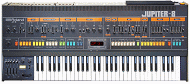
Comparison to a Jupiter-8
Here's a demo how close OP-X PRO-II can come to a Jupiter-8 with the right settings. The upper always is OP-X PRO-II, the lower
the real Jupiter-8. The examples are original factory presets from this synth:
34 Mellow Strings
34 Mellow Strings
84 Cello
84 Cello
|
|
75 Horn Fifths
75 Horn Fifths
82 Flute
82 Flute
|
|
76 Horn Tritone
76 Horn Tritone
33 Hi Strings
33 Hi Strings
|
|
21 Clav
21 Clav
38 Synth Brass
38 Synth Brass
|
|
22 Harpsichord
22 Harpsichord
35 Lo Brass
35 Lo Brass
|
|
|
The used settings can be downloaded as a bank here.
The original synth clips are licensed from www.synthmania.com
Mac/Win64: The bank is already included in Downloaded / PROII_JUPITER8FACTORIES
|
|
| |
Comparison Riddle
Here's a blind comparison to one of the most sought after early polyphonic synths, an Oberheim OB-X
Rev.2 which still has descrete filters and oscillators. Always one of the two files is OB-X, the other
OP-X PRO-II. The order through the groups may change or not. Which one is OB-X and
which one OP-X PRO-II? Does one of the two sound much worse than the other?
File 1
|
|
File 1
|
|
File 1
|
|
File 1
|
|
File 1
|
|
File 2
|
|
File 2
|
|
File 2
|
|
File 2
|
|
File 2
|
|
Solution: Goto "activeareas" in the top menu and click on the "Pan Presets" headline.
|
|
| |
System requirements
|
OP-X PRO-II is available for both the Windows and Mac platform in 32bit and 64bit format. The plugin
formats cover VST2 and VST3 in Windows and AU and VST3 in Mac.
More info on the demo version page.
- Windows XP SP2 or higher
- OS-X 10.8 or higher
- CPU: Core2duo or higher
- A 32bit or 64bit host supporting VST2, VST3 or AU
Free demo: here
| more info |
demo |
videos |
audio |
shop |
reloads |
|
|
|
Soundcard in Windows
|
OP-X PRO-II is relatively easy on CPU for today's standards. It even runs fine in cheap laptops.
For best performance however use:
- a dedicated ASIO soundcard or
- onboard sound with asio4all drivers
Normal standard windows system drivers produce an audible delay which isn't suitable for real-time playing. So ASIO drivers
are a must.
More infos available here
|
|
|
|
|
|
|
|
|