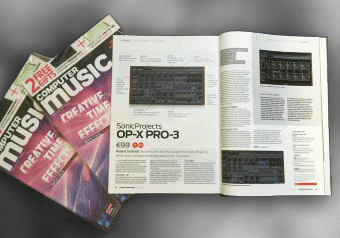
Yes, there IS criticism and we always were open for criticism and user feedback, also feature requests, which made us constantly working on improvements
already in the past which finally resulted in a product that users want and love. So we also will list this part here.
The negative criticism so far exclusively went towards the interface (initially also towards its color scheme, to which we reacted with providing
the two alternative skin colors blue and dark which users now like a lot) which at first glance looks very complicated and overly dense.
This of course is true given the fact that the synth offers a total of 199(!) parameters (in comparison, a 1979 OB-X e.g. had around 40
parameters) and is a one-pager - which means you can program everything from one page without the need to switch pages or going to
sub-menues - which makes programming EXTREMELY fast and intuitive once you have learned to operate it.
But we admit that there definitely IS a learning curve if you want to make use of all the provided features. So for in-depth-programming
you have to invest this time. We again may do a spoken tutorial video for easy and fun learning. A non-spoken videro tutorial already is
available
here
The basic controls you know from other synths
however are as easy to understand and program as in other more basic synths. So basic editing of a patch should be very easy even without
investing time into learning all the additional features.
Finally, there are as unbelievable many great ready-to-play presets (more than 3'000, and growing) included that you don't necessarily
NEED to program patches by your own from scratch. Even when we program patches we usually start from an existing patch, which is so much
easier since parameters already are set.
So our take is: Yes, for in-depth programming making use of all the countless incredible features you MUST invest some time into learning.
BUT you'll be granted then with inituitiveness and speed of programming.
Also - despite it may look more complicated than OP-X PRO-II, OP-X PRO-3 should be much easier to understand and program than OP-X PRO-II
since there are no hidden or mapped features anymore, and all features are labeled, and related features aren't spread accross the whole
interface as it still was in OP-X PRO-II but are gathered together in related groups (e.g. all LFOs in one section, all voice-management
controls in one section, all controls related to the filter in the filter section, which required a complete re-organization of the
interface, which was no easy task.
Nevertheless, the critisims made us think about maybe additionally providing an "easy" interface (switchable) in the future, maybe not
showing some lesser used in-depth-features at all. We'll see..
UPDATE: Some of the critizism has resulted in the new improved "Programmer's Edition" with a streamlined interface including tooltips and built-in color-switcher:
OP-X PRO-3 - Programmer's Edition
Check it out!